Guide · 17/11/2026 · by crizart
How to Split Expenses as a Couple: 3 Methods With Worked Examples
Fifty-fifty, proportional to income or everything pooled? Three ways to split household bills as a couple, each with the same worked example, plus what to agree on so money stops being an argument.
Money is a frequent source of arguments between couples, and rarely because of the sums themselves. What wears people down is having no rule: who paid for the last food shop, who is paying more, why one of you always has more left at the end of the month. Agreeing on a method takes those questions out of daily life. There are three, and none is right for everyone.
To compare them we use the same example throughout: Alex takes home 2,800 a month and Sam 2,000. Their shared household costs come to 2,400. The numbers work in any currency.
General information, not financial advice.
Before the method: what is a shared expense?
This is the first thing to agree on, and the one that prevents most misunderstandings.
- Usually shared: rent or mortgage, energy, water, internet, groceries, children’s costs, a shared car, home insurance, holidays together and joint savings.
- Usually personal: clothes, haircuts, hobbies, lunches at work, gifts, subscriptions only one of you uses.
There are grey areas: the gym, a car only one of you drives, a loan from before the relationship. There is no right answer. What matters is that it is decided.
Method 1: half each
Each of you pays 50% of the shared costs.
- Alex pays 1,200 and keeps 1,600.
- Sam pays 1,200 and keeps 800.
Upside: it is the simplest to explain and to do. Downside: when incomes differ, the lower earner is left with far less room. Here the household takes 43% of Alex’s pay and 60% of Sam’s. It works well when you earn about the same.
Method 2: proportional to income
Each of you pays the same percentage of what you earn. Three steps:
- Add the incomes: 2,800 + 2,000 = 4,800.
- Work out each share: Alex earns 58.3% of the total (2,800 ÷ 4,800) and Sam 41.7% (2,000 ÷ 4,800).
- Apply it to the shared costs: 58.3% of 2,400 is 1,400; 41.7% of 2,400 is 1,000.
- Alex pays 1,400 and keeps 1,400.
- Sam pays 1,000 and keeps 1,000.
Both spend half their pay on the household and keep the other half. Upside: the effort is equal. Downside: you have to redo the sum whenever a salary changes. It tends to make most sense when there is a big gap in income.
Method 3: pool everything, with an allowance each
Both salaries go into one account, which pays every bill and the savings. Each of you gets the same amount for personal spending, no questions asked.
- 4,800 comes in. 2,400 goes on shared costs and, say, 800 into savings.
- That leaves 1,600: 800 for Alex and 800 for Sam.
Upside: no more bookkeeping between the two of you, and saving becomes a joint project. Downside: it takes a lot of trust and agreement on priorities. It tends to suit couples with children or big shared goals, such as buying a home.
The three methods side by side
- Half each: Alex keeps 1,600 and Sam 800.
- Proportional: Alex keeps 1,400 and Sam 1,000.
- Pooled: each keeps 800, and the couple saves 800 a month.
In practice: three accounts
Whichever method you choose, this is the set-up that takes the least work:
- One joint account for household costs. Each of you pays in your share on payday by standing order, and every direct debit comes out of it.
- One personal account each for your own spending.
- One savings account for the emergency fund and your goals.
Nobody has to ask the other for half the energy bill, and one statement shows what the household costs each month.
What about bills that are not monthly?
Car insurance, annual subscriptions, holidays, Christmas. Add up the shared annual costs, divide by 12 and add that to each person’s monthly transfer. The money builds up in the joint account and the bill stops being a shock. Our guide to making a monthly budget spreadsheet shows how to set up these sinking funds.
Savings and the unexpected
A joint emergency fund is worked out from the household’s essential costs: three to six months is a common starting point. Decide too what happens if one of you loses your income through redundancy, illness or parental leave: the split should be reviewed then, not months later. The savings goal calculator shows how long it takes to get there.
One conversation a month
Twenty minutes, always on the same day, for example the first Sunday: did the joint account cover everything, what came in over budget, how are the savings doing. And review the split when something changes: a pay rise, a baby, a new home.
One rule that prevents a lot of arguments: agree an amount above which neither of you buys anything without talking to the other first.
Sheets that help
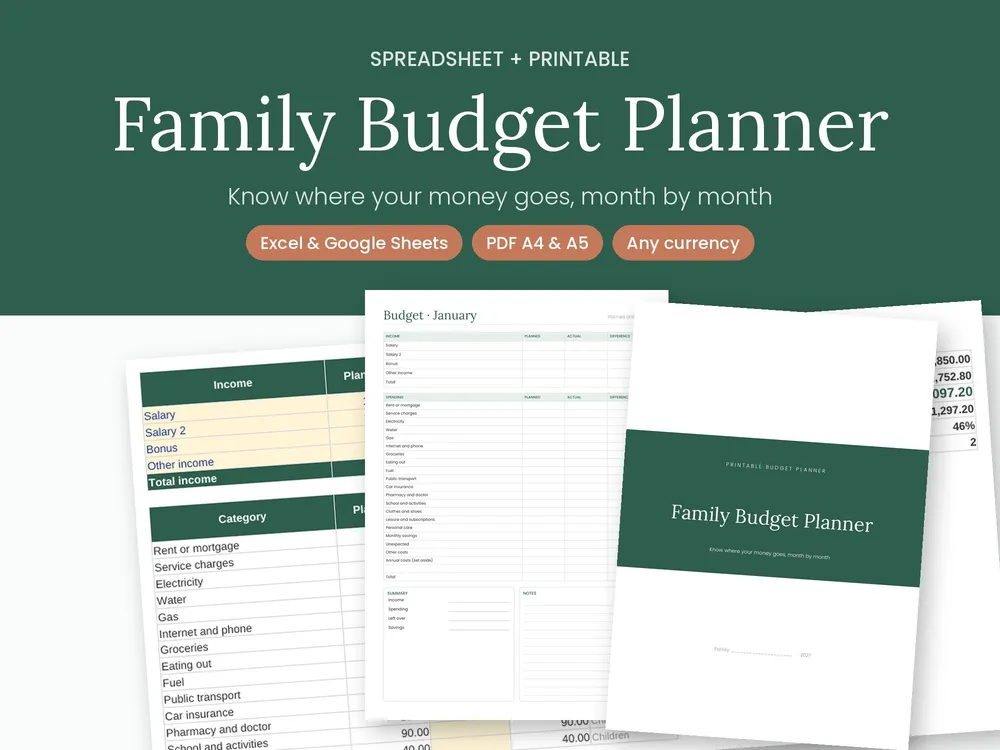
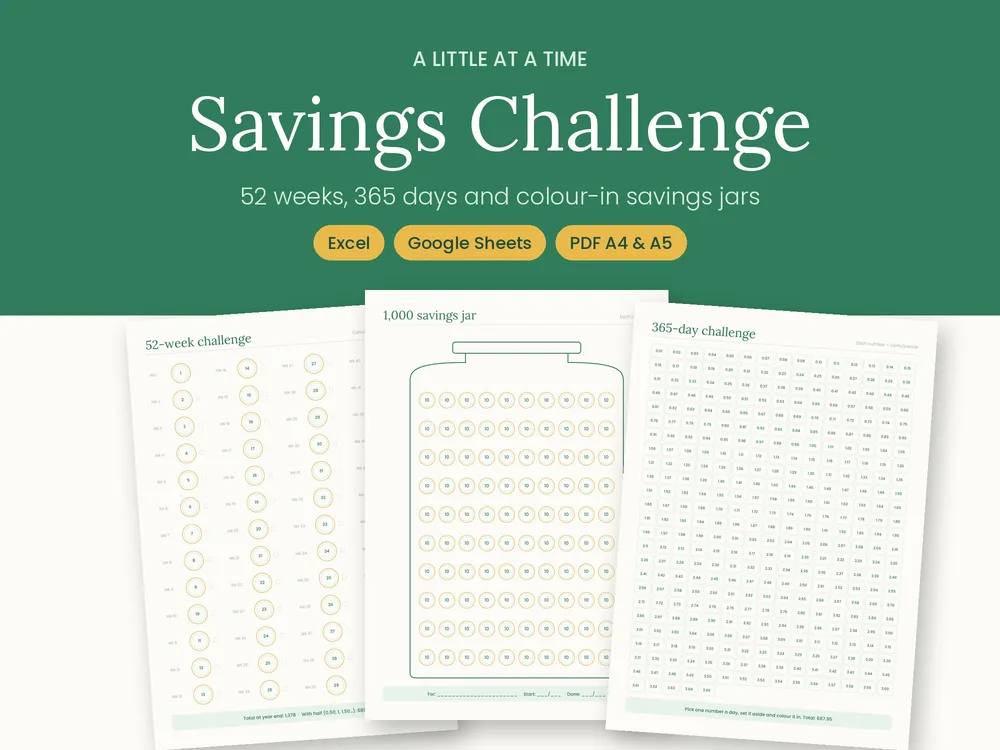
The free monthly budget spreadsheet is enough to list your shared costs. The Family Budget Planner 2027 follows the whole year: you enter what comes in and what you spend, and the spreadsheet does the sums. And the 12-month emergency fund plan that comes with the Savings Challenge 2027 works out your target from your fixed costs and how much to set aside each month.
Frequently asked questions
What is the fairest way to split bills as a couple?
It depends on your incomes. When you earn about the same, half each is simple and works. When there is a big gap, a split proportional to income asks the same effort from both: each of you puts in the same percentage of what you earn.
How do you work out a proportional split?
Add both take-home incomes and work out what share of the total each person earns. Each pays that share of the shared costs. With 2,800 and 2,000 the total is 4,800: one earns 58.3% and the other 41.7%. On shared costs of 2,400 that is 1,400 and 1,000.
Should couples have a joint account or separate accounts?
Many couples use both: a joint account that each pays their share into on payday and that all household bills come out of, plus a personal account each. You get transparency on shared costs and independence on personal spending.
What counts as a shared expense?
Whatever serves both of you or the family: rent or mortgage, energy, water, internet, groceries, children’s costs, a shared car, home insurance and joint savings. Clothes, hobbies, gifts and work lunches usually stay personal.
What if one of us stops earning?
Review the split straight away, not when money gets tight. This is also what a joint emergency fund is for: three to six months of essential costs is a common starting point.