crizart everything in its place
Guide · 04/11/2026 · by Cristiano
The 52-Week Savings Challenge: How It Works and How to Finish
How the 52-week savings challenge works: save 1 in week one and 52 in week 52 for 1,378 in any currency. Plus the reverse order, a half version and tips.
The 52-week savings challenge is one of the simplest ways to build a savings habit. There is no complicated maths and no app you have to sign up for: you put aside a slightly bigger amount each week for a year, and by the end you have a tidy sum you probably would not have saved otherwise.
Because it is based on plain numbers rather than a particular currency, it works the same in pounds, euros, dollars or anything else.
How the 52-week challenge works
The rule is easy to remember: the amount you save matches the week number.
- Week 1: save 1.
- Week 2: save 2.
- Week 3: save 3.
- …and so on, until week 52, when you save 52.
Add up every week from 1 to 52 and you get 1,378. That is 1,378 pounds, euros or dollars by the end of the year, saved in small steps. A quick way to check the maths: 52 × 53 ÷ 2 = 1,378.
The first few months barely feel like saving at all. By week 10 you will have put aside 55 in total; by week 26, halfway through, 351. The second half is where most of the money comes from, because the weekly amounts are bigger.
The reverse 52-week challenge
The classic version has one weak spot: the biggest amounts land at the end of the year, often in December, right when gifts and celebrations are already stretching the budget. That is when many people give up.
The fix is to do it backwards. Save 52 in week 1, 51 in week 2, and so on down to 1 in the final week. The total is exactly the same, 1,378, but the hardest weeks come first while your motivation is at its highest, and the challenge gets easier as the year goes on.
You can also start in any week of the year. Week 1 does not have to be the first week of January; it is simply the week you begin.
The half version: 689 in a year
If 52 in a single week sounds like too much, halve every amount: 0.50 in week 1, 1 in week 2, 1.50 in week 3, up to 26 in week 52. The total is 689. It is a gentler way to start, and you can always switch to the full version next year once the habit has stuck.
The same idea works the other way round. Double every amount and you will have 2,756 at the end of the year, if your budget has room for it.
Tips to actually finish the challenge
- Decide where the money goes. A separate savings account, or a savings pot inside your banking app, keeps it out of sight and out of your everyday spending.
- Pick a fixed day. Payday or Sunday evening both work. The point is to make it a routine, not something you remember now and then.
- Set up a transfer if you can. Some banks let you schedule a weekly transfer. If yours does not, set a reminder on your phone.
- Tick off every week. Colouring in a chart or crossing off a box sounds childish, but seeing your progress is a big part of what keeps you going.
- Do not panic over a missed week. Just catch up the following week, or pick an easier week from later in the list and do that one instead. As long as every number gets ticked off once, you still reach 1,378.
- Make room in your budget. The challenge works best when the weekly amount has its own line in your monthly budget, rather than coming from whatever is left over.
- Give the money a goal. A holiday, an emergency fund or next year’s Christmas: savings with a name are much harder to raid.
Other savings challenges to try
If the weekly rhythm does not suit you, there are other ways to play the same game:
- 365-day challenge: a small amount every day instead of once a week.
- 100-envelope challenge: number 100 envelopes from 1 to 100 and fill one at random each time, saving the number on it. All 100 add up to 5,050.
- Savings jar: draw a jar split into sections and colour one in each time you save, until the jar is full.
- No-spend month: a month with no non-essential spending, with the money you would have spent going straight into savings.
A ready-made tracker
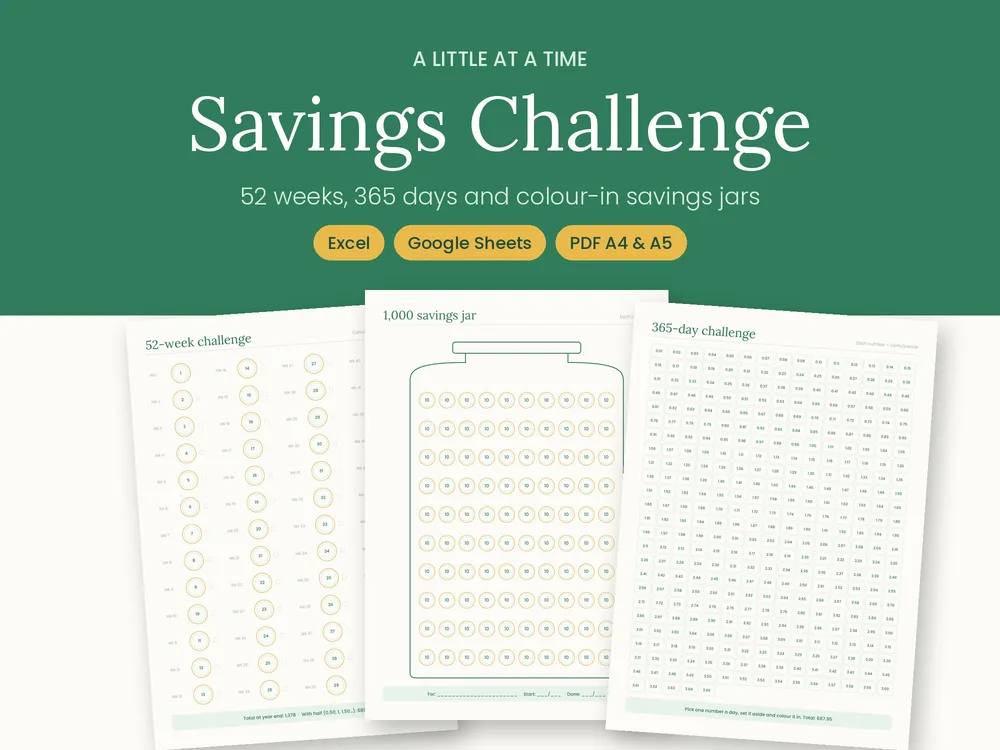
You can do the whole challenge with a pen and a piece of paper, but a printable tracker makes it more satisfying. The Savings Challenge 2027 includes the 52-week challenge in ascending or descending order, the 365-day and 100-envelope challenges, 500 and 1,000 savings jars plus a blank one, a no-spend month and a monthly savings log. The Excel spreadsheet, which also works in Google Sheets and on Mac, keeps track of your goals and progress with charts, and the printable PDF comes in A4 and A5. Amounts have no currency symbol, so it works with any currency.
And if you are not sure how much you can set aside each week, start with the free monthly budget spreadsheet to see where your money goes first.